Dover White SW 6385 by Sherwin-Williams - Paint Colour Review
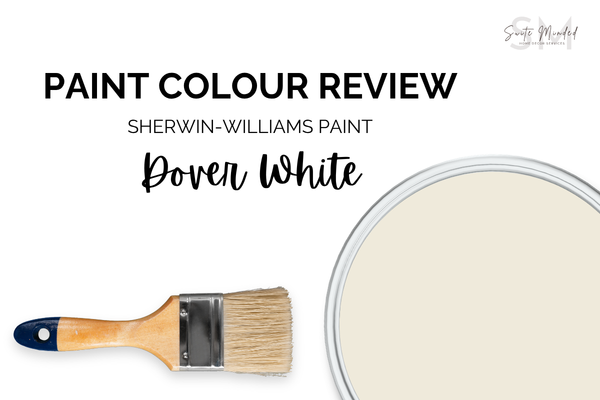
Not all whites are created equal, and Dover White is proof of that. While it sits firmly in the white category, it has a warmth and creaminess that sets it well apart from bright, clean whites or cool, grey-leaning ones. It's the kind of white that makes a room feel instantly comfortable, with a softness that suits many interior design styles. But that warmth is also something to understand before you commit, because in certain lights and alongside certain finishes, Dover White's yellow undertone can be more pronounced than you might expect from a paint chip. Let's dig into the details.
Undertones
Dover White's primary undertone is yellow, with a subtle hint of beige as a secondary undertone that gently softens and grounds the yellow. Together, these give it that signature creamy warmth that reads as distinctly more than just white.
In rooms with strong natural light, the yellow undertone can become quite noticeable, making Dover White look more like a creamy yellow than a soft white. This isn’t necessarily a problem, but it’s something to be aware of if you were hoping for a white that remains neutral across different light conditions.
One important thing to watch: if your fixed finishes have cool undertones, think grey or blue-toned stone benchtops, cool-toned flooring, or stainless steel appliances, Dover White's yellow undertone can clash in a way that reads as unintentional. It pairs most harmoniously with finishes that share its warmth.
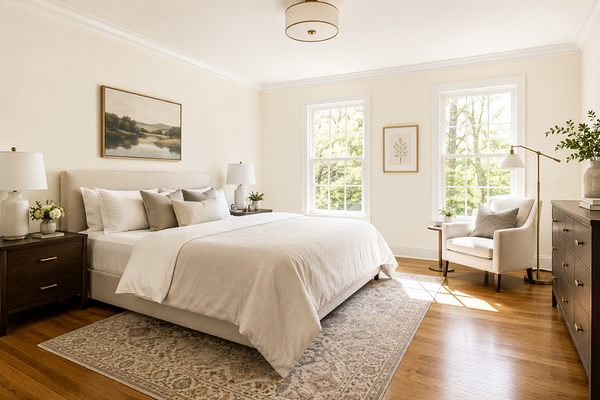
Bedroom with SW Dover White walls
LRV (Light Reflectance Value)
Dover White has an LRV of 83, which places it in the upper range, clearly a light colour, but with noticeably more depth than a bright white like Sherwin-Williams High Reflective White (LRV 93).
In practical terms, an LRV of 83 means Dover White will brighten a room without the intensity or potential glare of a very high-LRV white. It's a forgiving choice for rooms that don't get a lot of natural light, as it reflects enough to help the space feel open, but its warmth prevents it from feeling cold or washed out under artificial lighting. In a very well-lit or large room, the additional depth of Dover White helps the colour feel intentional, more intimate, and softly grounded.
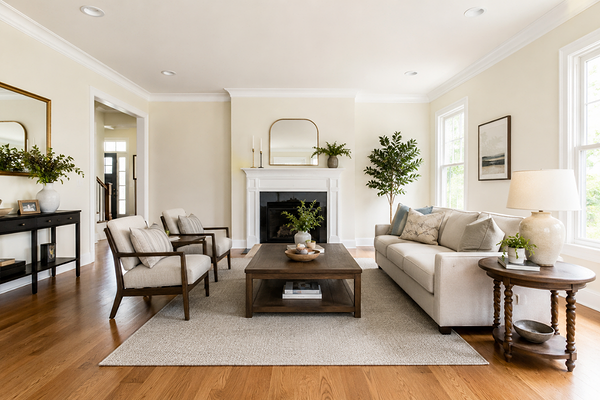
Living room with SW Dover White walls
How does Dover White look in different lighting conditions?
Because Dover White has a strong yellow undertone, lighting has a meaningful influence on how it reads day to day.
In north-facing rooms, which receive cooler, more diffused light, Dover White's yellow undertone appears slightly muted while still present. The result is a warm white that reads creamy and soft, one of the most flattering results for this colour, especially in areas where you want warmth without too much colour.
In south-facing rooms with abundant warm light, the yellow undertone activates even more, especially in peak afternoon sun. It reads noticeably creamier and warmer - still very pretty, but worth sampling at this time of day before committing. If your space gets intense direct sun, you may find a slightly more muted off-white with less yellow serves you better.
In east-facing rooms, the warm, direct morning sun brings out Dover White's creaminess at its most golden and inviting. As the light becomes cooler and more diffused through the afternoon, the yellow undertone settles back, and the beige subtly comes forward instead.
In west-facing rooms, the warm afternoon and evening light amplifies the yellow undertone, pushing Dover White firmly into creamy territory by late afternoon. This creates a wonderfully cosy, golden atmosphere in the evenings.
Check out this review of Creamy SW 7012, another warm white worth having a look at!
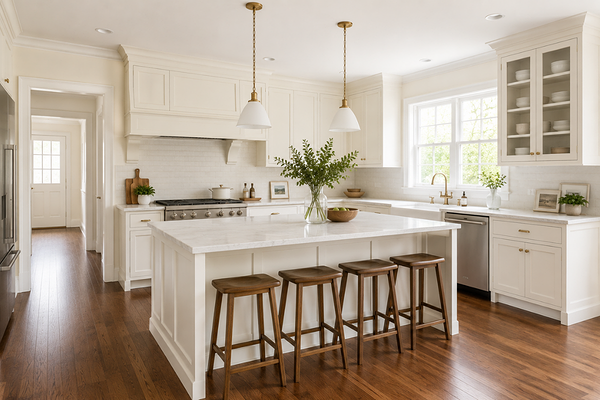
Kitchen with SW Dover White cabinets and walls
Best material pairings
Dover White's warmth makes it most at home alongside materials that share its organic, soft-toned quality:
Warm-toned timbers: Honey oak, warm pine, and mid-toned maple all sit beautifully alongside Dover White. The shared yellow warmth creates a cohesive, enveloping palette that feels genuinely inviting. Darker, richer timbers like walnut also work well; the contrast in depth is flattering without creating a colour clash.
Cream and ivory stone: Warm white marble, cream limestone, and ivory-toned travertine are natural companions. The soft stone tones echo Dover White's undertones rather than fighting them, a seamless, elegant pairing in kitchens and bathrooms.
Natural fibres and woven textures: Jute rugs, linen drapery, rattan furniture, and cotton upholstery in warm neutrals all feel at home with Dover White walls.
Antique and vintage brass: The yellow undertone in Dover White makes it a natural partner for warm metallic finishes. Aged brass, brushed brass, and antique gold hardware add richness and character.
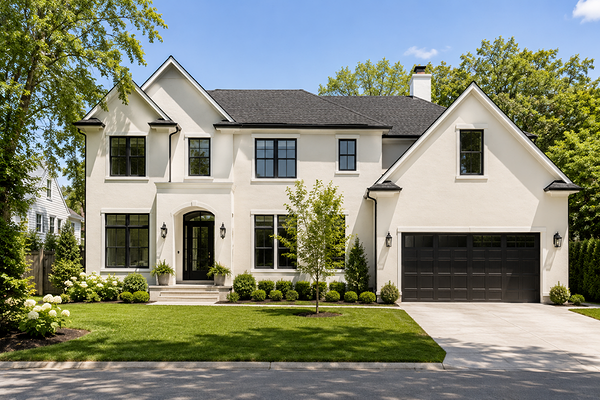
House exterior with SW Dover White walls
Where to best use Dover White
Dover White is particularly well-suited to spaces and styles where warmth and approachability are a priority:
Farmhouse and traditional interiors: Dover White's creamy warmth perfectly suits the relaxed aesthetic of farmhouse, cottage, and traditional interiors, particularly on shiplap, cabinetry, or as the primary wall colour throughout.
Kitchens and cabinetry: As a cabinet colour, Dover White delivers a warmth that bright whites like Pure White or Alabaster can lack. It creates a kitchen that feels timeless and welcoming.
Living rooms and family rooms: On walls in a well-used living space, Dover White creates a background that is liveable and versatile.
Bedrooms: The softness and warmth of Dover White make it a great choice for a restful bedroom, particularly in rooms with warm timber furniture or linen bedding in cream and natural tones.
Trims and architectural detail: Used on skirting boards, architraves, crown moulding, and door frames alongside a warm wall colour, Dover White creates a soft, tonal finish that feels considered and cohesive rather than high-contrast.
Exteriors: Dover White is a popular exterior choice for traditional and farmhouse-style homes, particularly on weatherboard or rendered surfaces. It pairs beautifully with natural timber, stone, or brick accents.
Where to use it with caution: rooms with predominantly cool-toned finishes (grey stone, stainless steel, cool timber), where the yellow undertone may clash; and very sun-drenched rooms where the yellow may become overwhelming and the colour reads more cream than white.
Best white trim colours
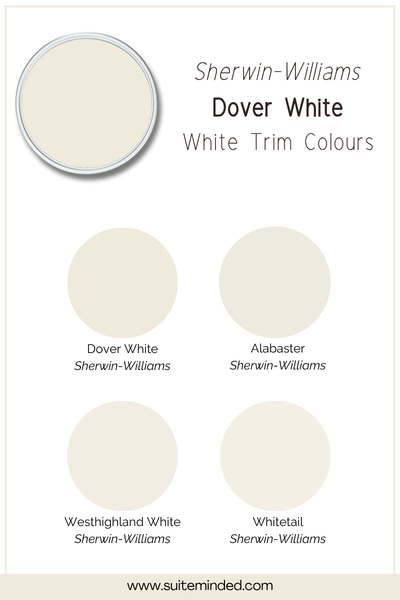
If applying Dover White to walls, choosing a trim colour requires care because its yellow undertone means cool or bright whites will read as mismatched rather than contrasting. The goal is to find a white paint colour that either matches DoverFcool White's warmth or nudges slightly lighter, creating a tonal result.
The simplest and most reliable approach is to use Dover White itself on the trims in a higher sheen, like semi-gloss or gloss. This creates a seamless, tonal result where the contrast is defined by sheen rather than colour.
If you want a slightly brighter trim, look for a warm white with a yellow lean, one that sits just a touch brighter than Dover White on the LRV scale but shares its warmth. Think Alabaster SW 7008, Westhighland White SW 7566, or Whitetail SW 7103.
A crisp, clean white will read as cold and jarring next to Dover White's creaminess, making the wall colour look yellower than it actually is.
Best coordinating colours
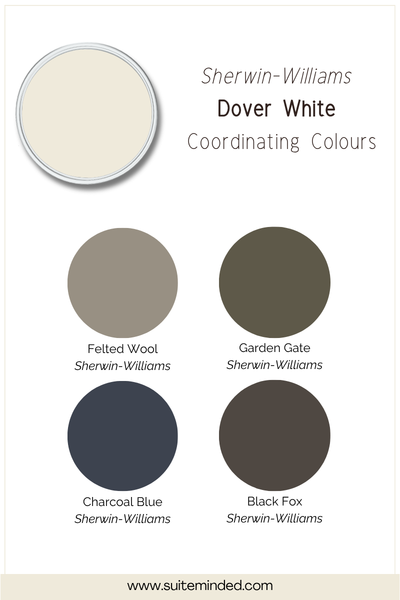
Dover White's warm, creamy touch makes it a natural partner for colours that share its organic, earthy character. Here's what works beautifully:
Warm greiges and soft taupes: A warm greige or sandy taupe on an accent wall or in an adjoining room creates a gentle, layered palette that feels cohesive and sophisticated.
Soft sage and muted olive: Warm, yellow-leaning greens feel at home alongside Dover White - the yellow undertone in the white echoes the warmth in these earthy greens, creating a palette that feels natural and grounded.
Dusty blue and soft slate: A muted, warm-toned blue creates a classic contrast with Dover White. The key is to avoid cool or saturated blues, which will clash with the yellow undertone; the softer and dustier the blue, the better.
Warm terracotta and clay: Earthy, orange-toned neutrals in furnishings or accent walls bring out the warmth in Dover White and create a palette that feels rich, organic, and inviting.
Deep charcoal with a warm touch: For contrast, a deep charcoal with brown or green undertones, rather than a cool blue-grey, grounds the palette without fighting Dover White's warmth.
Final thoughts on SW Dover White
Sherwin-Williams Dover White’s undertones give it a warmth that makes spaces feel instantly welcoming. With an LRV of 83, it has enough reflectivity to keep rooms feeling light and open, while its body and warmth ensure it never feels stark or clinical.
The key to using it well is understanding those undertones. Sample it generously in your space, at different times of day, and alongside your fixed finishes, before committing, especially if your room gets strong direct sun or if your finishes run cool. In the right environment, Dover White is hard to beat.
Want to know if Dover White is the right white for your home, or need help building a palette around it? I've got you.
Want a ready-made whole-house palette? Browse my Sherwin-Williams colour palettes in the shop - each one is designed to take the guesswork out of coordinating colours, trim, and accents.
Book a virtual colour consultation for personalised colour recommendations based on your home, your finishes, and your style, including whether Dover White is actually the right white for your space.
Have a question about Dover White? Leave it in the comments, I'd love to help.
Thank you for reading, and happy decorating!
Manon xx